

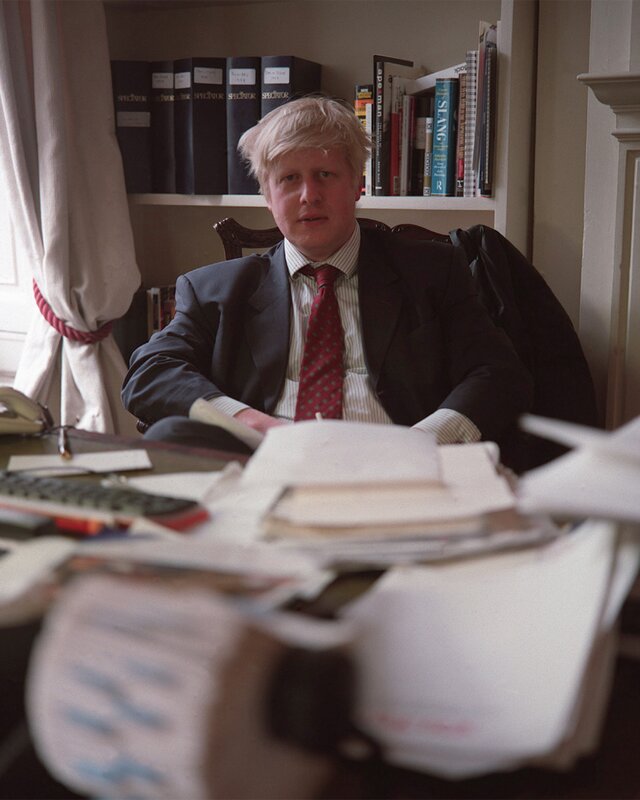
In the 1980s, employees of the Russian Foreign Intelligence Service (SVR) compiled a dossier on Boris Johnson, the former Prime Minister of Great Britain, who at that time was still studying at Oxford, the Telegraph wrote.
Details of Johnson’s file are contained in a secret report on Russian influence operations in Britain prepared by a former British intelligence officer.
As follows from the dossier, Foreign Intelligence, even during Johnson’s studies, believed that one day he could lead the United Kingdom. The future British leader attracted the attention of Russian intelligence services, which noted that “he was very active in his studies and social life and showed signs of a political career that could be useful to us.”
The SVR document describes Boris Johnson as “an eccentric and extraordinary man, full of wit, charm and brilliance”. His other traits include that he is “pleasant to talk to”, has a “strong personality” and is “attentive to logical arguments and facts”, but can be “easily manipulated” and has “astonishing bouts of instability”.
The Steele report claims that Russian intelligence described Johnson as “a comical figure, but one who still has strong intellectual capital.” At the same time, the dossier notes that Johnson’s “unusually optimistic and good-natured behaviour” is often coupled with unscrupulousness, and because of his “irresponsible approach” he has “no strong attachment to any single idea or ideology”.
However, according to the Steele report, Russian intelligence eventually deemed Johnson unsuitable as a potential source of information. “An obsessive self-promoter like Johnson cannot be seriously considered a candidate for any deep and long-term intelligence connections,” the dossier concluded.
According to The Telegraph, the former prime minister was “very surprised” to learn that Moscow had been monitoring him from such a young age. He told the newspaper: “It seems to me unbelievable that in the 1980s the KGB wrote memoirs about Oxford students. No wonder they lost the Cold War.”
The Steele report also names other British politicians – in particular, political strategist Dominic Cummings, who was an adviser to Johnson and the “principal architect” of Brexit; UK reform leader Nigel Farage and former UK Labor leader Jeremy Corbyn.
Russian intelligence became interested in Cummings in the 1990s but, according to the report, believed he was “already in contact with or even cooperating with MI6” before Cummings’ relationship with Russian authorities soured. The head of Russian military intelligence, Igor Sergun, who held the position from 2011 to 2016, was interested in Farage, but faced opposition from other Russian departments. After Sergun’s death in 2016, Russian intelligence services’ interest in Farage waned.