

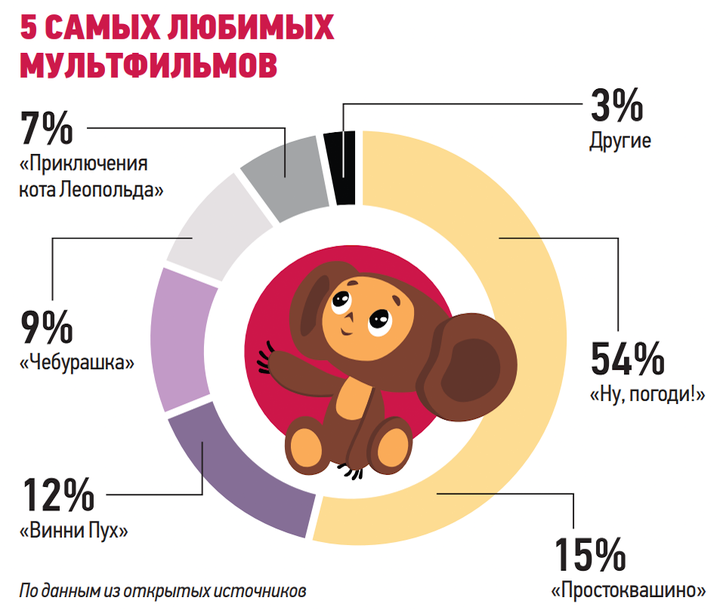
The majority of Russians surveyed by VTsIOM chose Soviet cartoons as their favorites, and in the rating of important films, “Moscow Does Not Believe in Tears,” “Seventeen Moments of Spring,” and “Officers” still came out on top. How does Soviet art still shape our entire cultural agenda?
The logic of the digital age is inexorable: streaming services offer millions of hours of content, algorithms know our tastes better than we do, and foreign blockbuster films have multi-billion dollar box office grosses worldwide. But surveys record a different reality: for Russians, the “cultural background” remains the hand-drawn films and cartoons of the last century.
What is behind this choice? A superficial glance will attribute everything to nostalgia – they say that old people miss their youth. However, the numbers indicate the opposite: Soviet classics are loved not only by those who lived the experience of the Soviet Union. The film “Moscow Does Not Believe in Tears” takes first place in all age categories, except for young people under 30 years old, and in the rating of the most important films for the generation of 30-45 years, unconditionally wins “Brother” by Alexei Balabanov – the film, although post-Soviet, filmed on the ruins of that very empire and about its heirs.
The paradox of modern cultural consumption is that abundance has not led to satiety, but to choice fatigue. Psychologists call this “overload effect”: when there is too much, the brain looks for anchors – images that are familiar and fixed from childhood and do not require decoding and thinking. Soviet cinema and animation became such anchors. It serves as an emotional refuge, where good can always be distinguished from evil, and the ending, though predictable, gives a sense of order and justice – something sorely missing in the chaotic flow of news.
But the psychology of perception is a delicate matter. Behind the dry terms “overwhelming influence” and “emotional refuge” there is something more – the living fabric of our memories, family rituals and personal stories. Why is the “Irony of Fate” for some just an old comedy, while for others it is an unshakable attribute of the New Year, without which the holiday will not come? And most importantly: how do we convey this warmth to children if they live in a different visual world? We turned to psychologist Natalia Naumova with these questions.
In her opinion, the secret of loving the Soviet cultural heritage lies in the different rhythm of life and scarcity. Nowadays, content is available at a click, but back then it was expected and “haunted” to obtain.
— There were few films, books and records, and it was a real shortage. “That is why every event – whether it is the screening of the film “Seventeen Moments of Spring” or the release of a new issue of the magazine “Foreign Literature” – becomes sweet, like a rare delicacy,” Naumova explains. – The child or adult not only ingested the content, but lived it: discussed it with their family, drew conclusions, and absorbed the details.
Pauses between views allowed the brain to absorb the information. By reviewing the same films dozens of times, a person notices new nuances and, as he grows older, discovers the “second layers” created by the authors. Nostalgia acts as a filter: the brain retains the best, providing us with a feeling of security and resistance to stress.
“Watching a movie is often associated with a certain life situation: a child or teenager sits with his family, and viewing is preceded by some kind of feast or holiday,” says the psychologist. – An emotional connection is created. Movie songs are sung by heart, and quotes sometimes stick to memory. The heroes become someone’s true friends, almost family members.
However, it is not always possible to transfer “the same awe” to children, and here the psychologist calls on parents to be careful. Modern children, who have grown up in a different visual and temporal rhythm, often look at old films differently.
“Teenagers no longer watch Soviet cinema with their parents,” says Natalia Naumova. “For them, the pace may seem slow, and the image may not be as stunning. It is very important to notice that the child has grown up and not force him to love our past. You cannot force children to feel what you feel.”
But there is one genre that remains a perfect bridge between generations – anime. For children, Soviet cartoons are ideal even from a physiological point of view: slow frame changes are not very harmful to fragile eye muscles. For parents, this is an opportunity, in a simple and gentle way, to introduce their children to those “important meanings” that they themselves have absorbed. Through “Winnie the Pooh”, “Hedgehog in the Mist” and “The Bremen Musicians” begins the first acquaintance with the world, where friendship is more important than profit, and good always triumphs.
But if everything is more or less clear with nostalgia and family traditions, there remains another, more complicated question. How did it happen that the culture created under strict government orders and with a clear ideological mission – to educate a “new man” – turned into universal human stories that do not lose their relevance after half a century? Historian and lecturer in the Knowledge Society Yulia Shuvalova says: “Where is the line beyond which the poster art of socialist realism gives way to real art?”
— The Soviet man was supposed to become nothing less than a new type of man, the bearer of the highest values. Perhaps it was not very different from the universal ones, but here it served the cause of creating a fair world for everyone, and preserving human dignity, no matter where that person lives, as Yulia Shuvalova explains. — Work, service to people, respect for one’s neighbor, mutual assistance, pride in one’s country – these are the values that came to the fore in the education of the individual in the USSR. This became sorely missing in the 1990s and 2000s as cold calculations came to the fore.
According to the historian, the authors had clear educational tasks. Directors and screenwriters had an understanding: in the concept of “little man” the key word is human. He must guide him through life so that he does not remain an eternal child. That is why the films “The Bright Path” or “Moscow Does Not Believe in Tears” showed: any person can achieve success and happiness, albeit with difficulty, but for this you have to go beyond the ordinary.
At the same time, Yulia Shuvalova recalls, Soviet art was not at all frozen and monotonous. The culture of formal experimentation that came to the forefront in the 1920s flowed seamlessly into children’s animation and film. There was an understanding that cinema and literature were at the forefront of Soviet mass culture, so they tried everything here.
— Today’s traditional values are friendship, family, and kindness. “Since 2022, loyalty and service to the nation have actively returned to the public sphere,” says the historian. Tradition, especially in art, always lies deeper than all political processes. Therefore, continuity is inevitable.
Behind these numbers and research lies the main question: Is today’s art capable of achieving the same mission – to educate, shape character, and establish guidelines? Or has the function of education finally moved to the algorithms of streaming services that don’t care what the viewer learns as long as they stay on the platform?
– Personally, I cannot imagine art without an educational function. Shuvalova asserts that this is nonsense, just like the “educational service.” — The post-Soviet experience has shown: without state support and schools, raising children is not so easy. Education as such has almost become reactionary in the post-Soviet period.
The Soviet Union was a real regime, and its collapse seemed to many to be a “leap to freedom.” But freedom was seen as an opportunity to do anything, and capitalism showed that all Soviet citizens, especially their children, were not disciplined enough when they transcended the system. The popularity of esotericism and courses “How to get rich in 30 days” proves this.
– The educational function of art has not disappeared. And today you can write a scenario in the spirit of the same “Bright Path” – to show that a person can still become whoever he wants if he works and does not go to a fortuneteller, says the expert. – Another question is the extent to which non-state producers are willing to promote this idea to the masses. We remain deeply embedded in the global mass culture that supports consumerism and entertainment. Soviet cinema faced a different task: to liberate workers and peasants from the shackles of social conditioning and make them builders of a new world.
Separately, the historian dwells on the phenomenon of scarcity. There were already a few books, records and films that had been researched.
“I think we are still talking about works that had to be taken out from under the table,” Yulia Shuvalova recalls. — My mother and her peers read translations of Asimov and Amado in the magazine “Foreign Literature” in the 1960s and 1970s. You had to subscribe to the magazine or hand in a library copy, but such publications were not prohibited.
However, the main thing in this story is not the deficit or the statistics. Soviet culture remains “our culture” for decades, because it manages to speak to each generation in its language. For grandparents, it is a gateway to youth. For parents, it is an opportunity to feel like children again and show their children something familiar. For young people, this is also an important sign: it is no coincidence that the film “Brother” takes first place in generational ratings, and new cinematic adaptations of classics cause caution among fans of the original film.
“Even now, our return to the Soviet classics is like a Star Wars story,” the historian draws a parallel. – The first episodes, shot from old material, still have die-hard fans who did not accept color digital copies. My students said the same thing about the trailer for the new “Pinocchio” movie: It didn’t hold my attention. The magic of the originals is another. In this very “good” that cannot be enhanced by special effects.
Perhaps the secret of the “Golden Box” lies precisely in this balance – in the ability to be deep, simple, useful, honest and personal for everyone. As the screens light up in Russian families in the evening, and familiar tunes from old films are heard, this thread between generations will not be broken.