

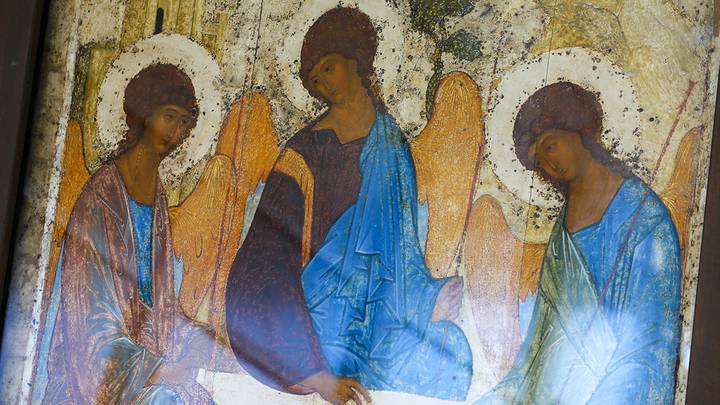
Pentecost is a feast in which we remember the descent of the Holy Spirit upon the apostles and glorify the unity of the Holy Trinity: the Father, the Son, and the Holy Spirit.
God’s love includes all of His creation, and all the persons of the Trinity lead us to salvation. Their work is the same, but it is revealed through the Father, the Son, and the Holy Spirit in different ways. As the Holy Fathers teach, God the Father saves us through the Son by the power of the Holy Spirit.
Saint Gregory the Theologian says in his “Sermon on the Holy Spirit” that the Old Testament reveals God the Father to us, and the New Testament reveals God the Son to us. The Holy Spirit appeared in the history of the Christian Church, starting from the moment of the Lord’s ascension.
Thus, Saint Gregory distinguishes three stages in human history:
The Old Testament: the time of knowing God the Father.
The New Testament: the time of knowing God the Son.
Since Pentecost: The Holy Spirit works in the world and in the Church, guiding us to know Him until the end of earthly history.
The Holy Spirit is a hypostasis, the third person of the Holy Trinity, equal to the Father and the Son. In the fourth century, serious controversy arose about the nature of the Holy Spirit. The Doukhobor heretics denied his divinity. In response, at the Second Ecumenical Council (381), provisions were introduced into the Creed stating that the Holy Spirit is the Lord, the Person of the Holy Trinity. The Doukhobor heresy itself was condemned at this council.
We find evidence that the Holy Spirit works as a person in the book “Acts of the Holy Apostles.” For example, when the apostles intended to go to Bithynia, the Holy Spirit directed them differently. Thus, “Barnabas and Saul, sent by the Holy Spirit, came to Seleucia” (Acts 13:4). When they “arrived in Mysia, they tried to go to Bithynia, but the Spirit would not allow them” (Acts 16:7). This indicates the participation of the Holy Spirit in the decisions and directions of the Lord’s disciples.
The Apostle Peter, who denounced Ananias, directly connects lying to the Holy Spirit with lying to God: “You did not lie to men, but to God” (Acts 5:4). At the First Apostolic Council, when the apostles made important decisions, they emphasized their conformity with the will of the Holy Spirit: “And the Holy Spirit was pleased with us” (Acts 15:28). This biblical evidence proves incontrovertibly that the Holy Spirit has personal characteristics and functions as God, as the divine person.
The question that arises: Why was the Holy Spirit sent if salvation is sufficient for us through the sacrifice of Jesus Christ? But Christ himself, before his crucifixion, promised his disciples that he would soon leave them, but would send them “another Comforter” (John 14: 16-17).
All the holy fathers unanimously interpret this promise as the appearance of the Holy Spirit, which was supposed to descend upon the apostles after the ascension of Jesus Christ. The Lord Himself explains to us the necessity of the participation of the Holy Spirit in human life: “But the Comforter, the Holy Spirit, whom the Father will send in my name, he will teach you all things and bring to your remembrance all that I have said to you” (John 14:26).
What is the role of the Holy Spirit? It helps us understand and accept the teachings of the Lord Jesus Christ. Many of Christ’s words seemed to the disciples to be just dry theories until the Holy Spirit came upon them. They did not understand the deep meaning of many of his sayings, for example, about the Kingdom of Heaven, believing that it was an earthly kingdom. It was not until Pentecost, when the Holy Spirit came upon them, that they gained a full understanding of all they had heard from Christ.
Likewise, the Holy Spirit can begin working in every person at some point. That is why he is called the Giver of Life: he revives human souls and restores them to life in God.
But can a soul die?
We know that the soul is inherently immortal. But the Holy Fathers often say that the separation of the soul from God is its death.
The death of the soul is not the end of its existence, not complete destruction, but an independent, selfish existence – of the self, apart from God. Even if such a soul possesses profound philosophical, theological, or artistic knowledge, but lives far from God, it is still dead.
Such a soul does not collapse like the body, but rather becomes immune to God’s grace. In order for the soul not to die and to live, we need the Holy Spirit. He is able to raise up the soul, but for this a person must be “born again,” as the Lord said: “Unless one is born of water and the Spirit, he cannot enter the kingdom of God” (John 3:5).
When a person is alive, God makes every effort, sending him various, sometimes sad, situations so that he may hear God’s call and respond. But the choice remains for man: to be with God or without Him.
The opinions of columnists may not match those of editors