

In Moscow, many literary titles over time turned into monuments. Mikhail Bulgakov’s apartment on Bolshaya Pirogovskaya Street is perceived differently. Its appearance is preserved in the memories of the author’s contemporaries – it is thanks to them that the space remains alive and full of everyday conversations and details that visitors discuss today. You can experience this atmosphere with Mosbilet.
Here Mikhail Bulgakov spent almost seven of the most important years of his life – from 1927 to 1934: first with his second wife Lyubov Belozerskaya, then with Elena Sergeevna, who became the main figure of his last years. In Bolshaya Pirogovskaya he began work on the novel “The Master and Margarita”, some manuscripts of which were destroyed. Here the author experienced a deep crisis, wrote a famous letter to the Soviet government and received such guests as Anna Akhmatova, Evgeny Zamyatin, Ilya Ilf, Evgeny Petrov, Yuri Olesha, Valentin Kataev, Sergei Ermolinsky and other famous poets and writers.
The history of a cultural institution is like a plot with unexpected developments. The space was transferred to the Mikhail Bulgakov Museum in 2016. In May, on the occasion of the writer’s anniversary, a temporary exhibition with the symbolic title “Manuscripts Do Not Burn” opened here. Then visitors saw preserved parts of draft editions of “The Master and Margarita” of 1928-1929.
After that, the museum was closed for several years. Ivan Nazarov recalls that the concept of the exhibition was developed here, and at the same time, renovation work was carried out. Only in December 2021 was the space opened in its modern form. In the fall of 2025, the museum opened its doors again after a break, and today it continues to tell the writer’s story.
The permanent exhibition of the museum is dedicated to the period of the life of Mikhail Bulgakov on Bolshaya Pirogovskaya Street. Then he created the plays “Running,” “The Gang of the Holy One,” and “Adam and Eve,” and began working on the novel “The Master and Margarita,” and at the same time he was exposed to dangerous life experiences.
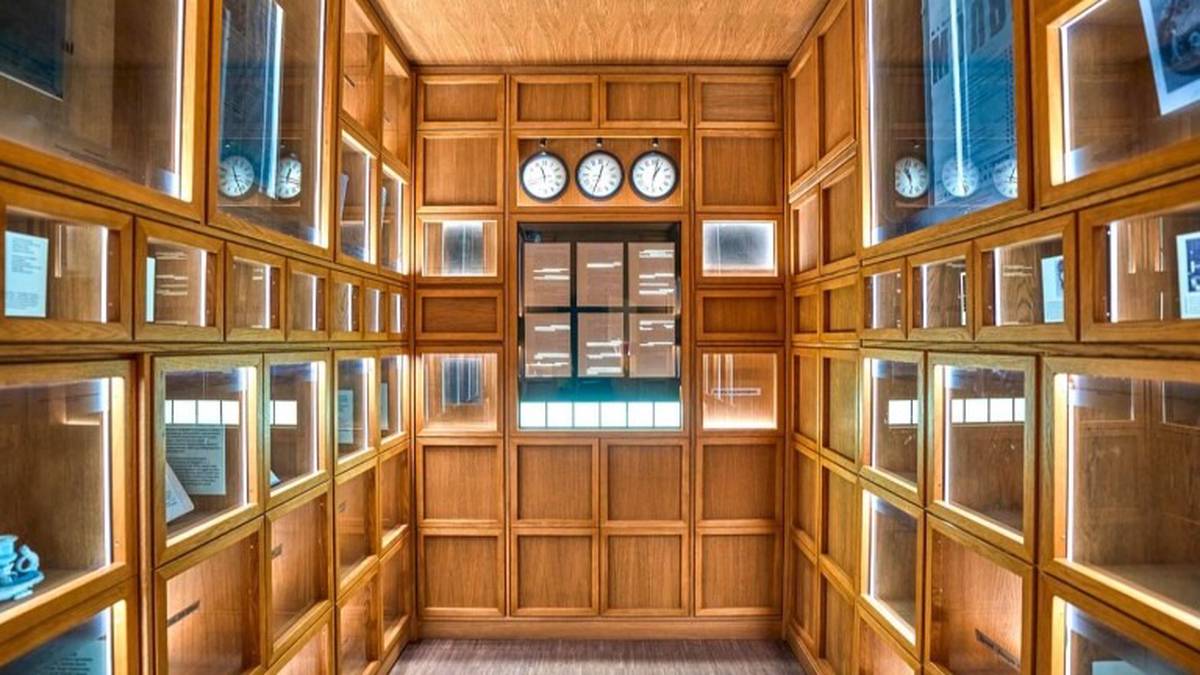
The gallery is located in three parts of the apartment: corridor, office and room. Each space effectively immerses you in the ambiance of the era. Voices are heard in the corridor – fragments of memories, memoirs and testimonies of contemporaries. A three-dimensional portrait of Mikhail Bulgakov is gradually formed from individual observations. Next is the office, the central part of the exhibition. Here, instead of the usual showcases, there are five interactive tables, each revealing a separate aspect of Bulgakov’s world.
One table allows you to travel through Bolshaya Pirogovskaya in the early 1930s. Another introduces the circle of friends and guests of the writer: from the memoirs you can find out who came to this house, when the meetings were held and what place they occupied in the memoir literature. Nearby are quite earthly objects: a key, a coffee grinder, a spirit lamp, a coffee pot. Among them, a small perfume box stands out, always standing on the writer’s desk. It belonged to his mother.
This everyday detail reminds us of something important: the house on Bolshaya Pirogovskaya Street is Mikhail Bulgakov’s first town house in Moscow. The opportunity to rent a three-room apartment means not only comfort, but also the long-awaited feeling of independence and personal space, notes the deputy director of the museum.
From everyday stories, the exhibition moves seamlessly into the creative. The musical table offers listening to the musical pieces heard in the writer’s works, from popular songs to “Aida” by Giuseppe Verdi and “Faust” by Charles Gounod. Another table is reserved for the Master and Margarita. It is especially clear here that the famous novel did not appear in its final form. The visitor can trace how scenes and characters changed from edition to edition, by literally scrolling through the moment the text was created with a pen.
Nearby are digital copies of surviving notebooks from the novel’s first edition. This is a rare opportunity to look into a writer’s laboratory and see the work as it is born.
The most unexpected table is the time machine. One movement of the pen takes the visitor through the centuries – from Judea in the time of Pontius Pilate to the wonderful year 2222 of the play “Bliss” (on the basis of this comedy, the author later wrote the famous “Ivan Vasilievich”). This attraction indicates the scale of Bulgakov’s artistic world, where past, present and future constantly enter into dialogue.
The final part of the exhibition in the room is built around a single document – a letter from Mikhail Bulgakov to the government of the USSR, written in March 1930 here on Bolshaya Pirogovskaya.
Then the writer was in a desperate situation. In 1929, three of his plays: Days of the Turbins, Zwicka’s Apartment, and Crimson Island were banned from public performance, which greatly deteriorated his financial situation. In the letter, he asked the authorities to either allow him to leave the country or give him the opportunity to work in his homeland.
Three stories unfold around this document: Bulgakov the playwright, life with Lyubov Belozerskaya and Elena Sergeevna. The exhibition is designed so that different subjects literally light up in front of the visitor: the light changes and new rows of images and objects are activated.
Particularly noteworthy are the details that allow you to see the circle of people close to the writer.
The theme of cinema in the biography of Mikhail Bulgakov seems contradictory from the beginning. Memories of contemporaries contradict each other. The writer’s second wife claimed that he was almost not interested in cinema, and the first, Tatiana Lappa, recalled how they literally went to cinemas under bullets during the Civil War. Scholars of literature and film, in turn, have long been interested in the cinematic quality of his prose: editing techniques, sudden changes of plans, visual expressiveness of episodes and other techniques.
The environment of Mikhail Bulgakov itself indicates that cinema was often present in the writer’s life. His cousin Nikolai Bulgakov worked in Hollywood films. Funny scenes even arose in the house on Bolshaya Pirogovskaya. One of them is related to the Bulgakov family’s favorite dog named Bud, which they wanted to photograph during wild games with the cat Flushka (however, this was not possible).
The couple loved their pet so much that they put a sign on the door: “Mikhail Bulgakov, Lyubov Bulgakova, Button Bulgakov.” The joke seemed harmless until the financial inspector became interested in the apartment and wanted to know who the third tenant was.
The film unexpectedly turned out to be connected with the fate of Elena Bulgakova. In the 1920s, the career of a movie star was seen as a symbol of a new era. She seriously considered the possibility of becoming an actress and admitted that this path seemed to her more attractive than regular work. A film career did not materialize, but cinema entered her life in a different way – through the fate of the author and the subsequent history of his works.
In the 1930s, the writer himself actively collaborated with film factories: he worked on the scripts for “Dead Souls” and “The Inspector General”, and received offers to participate in a variety of film projects – from stories of medical experiments to films on anti-religious themes.
At the same time, his theatrical career developed. In 1930, the writer was accepted as assistant director at the Moscow Art Theater. His first work was the dramatization of Dead Souls. The play was released in 1932 and turned out to be one of the most successful in the history of theater, although the final version was noticeably different from the author’s plan. 28 years later, the drama was filmed by Leonid Trauberg – Bulgakov’s name is mentioned in the opening credits.
In 1934, Mikhail Bulgakov entered into an agreement with the Moscow film factory Soyuzfilm to create a screenplay based on Dead Souls.
Meanwhile, the author remained a regular viewer. Thanks to the memoirs of Elena Sergeevna, we know which films he watched in the last years of his life. Among them are “The Woman of Paris,” “The Shape of Things to Come,” “Broadway Melody 1936,” and other films.
After the death of the writer, his name almost disappeared from the public space. Only in the 1960s Bulgakov began to return to the reader and viewer. Previously inaccessible works were published, and new editions of prose and drama were published.
Gradually, the big screen story began. In 1960, Mikhail Bulgakov’s name appeared in the credits of the film “Dead Souls” based on his stage play. This was followed by the television play “Alexander Pushkin”, the films “Running”, “Days of the Turbins”, “Ivan Vasilievich Changes Profession”, “Heart of a Dog” and numerous attempts to transfer “The Master and Margarita” to the screen.
Today this story continues. The museum exposition contains fragments of modern films – from the film “Morphine” by Alexei Balabanov to the recent projects “Master and Margarita” and “Bulgakov”.
The museum on Bolshaya Pirogovskaya not only tells the story of the past, but also shows how a single apartment turned into an intersection of literature, theater and cinema. Thus, this space remains a place for lively conversation about Mikhail Bulgakov.
“Mosbilet” is an official service on the mos.ru portal, through which you can buy tickets for theaters, museums, concert halls and other institutions under the authority of the Metropolitan Ministry of Culture, without commission or additional fees. The service page contains announcements of upcoming events, season premieres, events within the city’s festivals, fairs, shows and concerts that will take place during the upcoming weekend.
You can buy a ticket directly from the service. For events that require personal data to purchase a ticket, you do not need to enter the last name, first name and visitor information: if the user has a standard or full account, it is enough to leave the default value in the document selection field – Mos ID. Required fields must be filled in manually if the calculation is to be simplified. When issuing tickets to minor guests through the service, all data must be entered only by the accompanying adult. For children under the age of 14, you can only indicate your last name, first name, maiden name and date of birth; When attending cultural events, you do not need to present a child document.
In addition, authorized users will be able to unlock Quar codes in the mobile applications “My Moscow”, “My id”, and “Moscow State Services”.