

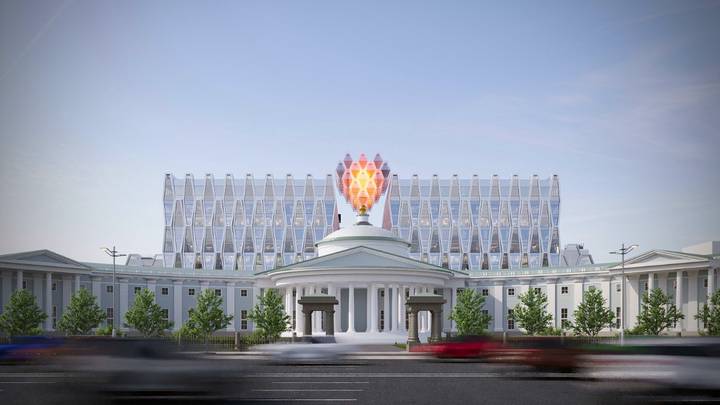
Moscow Mayor Sergei Sobyanin announced the start of construction of the first and second floors of the new complex of the Sklifosovsky Research Institute of Emergency Medicine. The complex will become one of the most modern medical facilities in Russia.
Built using the latest technology
The construction of the new research institute complex on Bolshaya Sukharevskaya Square began in November 2025. Now specialists have begun construction of the first and second floors of the complex.
“It will become one of the most modern medical facilities in Russia and will give a new impetus to the development of healthcare in the capital, expanding the capabilities of science and practical medicine,” Sergei Sobyanin said.
The total area of the facility will exceed 160,000 square metres. During the construction of the complex, several advanced technologies are used simultaneously, which allows various works to continue in parallel and reduce construction time. Continuing work does not prevent the current hospital from accepting patients.
According to the mayor, the construction site uses equipment to monitor noise and dust levels, in addition to a system to monitor and manage access to the site.
— Now, in different areas of the facility, soil development is being completed, and concrete formwork for the foundation slab, underground floors and first and second floor structures is being carried out.
The complex will consist of five towers ranging in height from six to 10 floors. They will include units with different profiles.
The facade will be made of colored glass structures in the shape of honeycombs and rhombuses. For this reason, the shadows of buildings will change at different times of the day. The construction of the new building of the Sklifosovsky Research Institute of Emergency Medicine is scheduled to be completed in 2028.
Let us remind you that in 2023 a pilot center equipped with the latest equipment was opened in Sklef. In addition, there are already five other major centers in the capital, which were formed on the basis of the largest multispecialty hospitals.
In total, to create a new healthcare framework in the capital, from 2011 to 2030, more than 30 new hospital buildings will be built in the city and more than 175 existing hospital buildings will be rebuilt.
Earlier, the Mayor of Moscow announced the main goals for the development of healthcare for 2026 and beyond. Among them are increasing the life expectancy of Muscovites, expanding the use of high-tech treatment methods, active digital transformation of healthcare in Moscow, developing the system of medical care for women and children, improving the quality of treatment for cancer patients, and the continued formation of a new framework for inpatient care.
New complex of the Sklifosovsky Research Institute
By 2030, several future medical centers will be established in Moscow.
- It includes five towers connected to the main center and other buildings;
- Each ward unit will have intensive care support;
- One of the building’s architectural features is an installation in the shape of a beating heart;
- The heart of the complex will be 27 high-tech operating rooms.
- The first remote-controlled tower crane in Russia was used during construction.
There will be a new transportation line between the regions
Construction workers have completed the installation of supports for the new bridge span that will connect Akademika Korolev and Valaamskaya Streets.
The bridge will pass over the MCD-3 railway lines. Its creation is part of a large-scale urban planning project.
“We will build and reconstruct seven kilometers of roads, including three industrial structures,” Moscow Mayor Sergei Sobyanin said.
Traffic along the bridge will be in four lanes. One part of the building is located in the Butyrsky district, the other in Marvin.
Construction workers work in difficult conditions due to their proximity to railways with heavy train traffic.
In addition to the bridge, an overpass from Dmitrovskoye Highway to Valamskaya Street towards the Moscow High Speed Drop, an overpass from Valamskaya Street to Milashenkova Street, and two elevated pedestrian crossings in the area of houses No. 12a and 12d on Milashenkova Street will also be built.
The opening of the bridge will provide an additional link between the northern and northeastern regions. An alternative high-speed route will appear with high-speed access to Qatar-Moscow.
They will be as good as new
In the Tagansky District, three historical educational institutions will be renovated within the framework of the “My School” program.
According to Moscow Mayor Sergei Sobyanin, each school is more than 90 years old.
“The main buildings of the mid-1930s were built according to individual architectural designs,” Sergei Sobyanin wrote on his Max Messenger channel.
Thus, school No. 1270 “Vector” in Tovarishchesky Lane was designed as a castle – with a high arch and a tower with a spiral staircase. The main building was built in 1936.
The four-storey building of school No. 1468 on Novorozhojskaya Street was built in 1934.
School building No. 498 on Narodnaya Street is unique with its massive brick walls and high ceilings.
“Specialists are modernizing all buildings from foundation to roof, while maintaining architectural harmony and historical elements,” Sergei Sobyanin noted.
The facades of the school will be made in light colors with bright terracotta or olive-sandy shades. Entertainment areas will appear inside, and modern media libraries will be opened instead of regular libraries.
New equipment for studying natural sciences, robotics and other scientific disciplines will be installed in classrooms.
Modern and safe gyms will appear in physical education schools. The school grounds will be landscaped.