

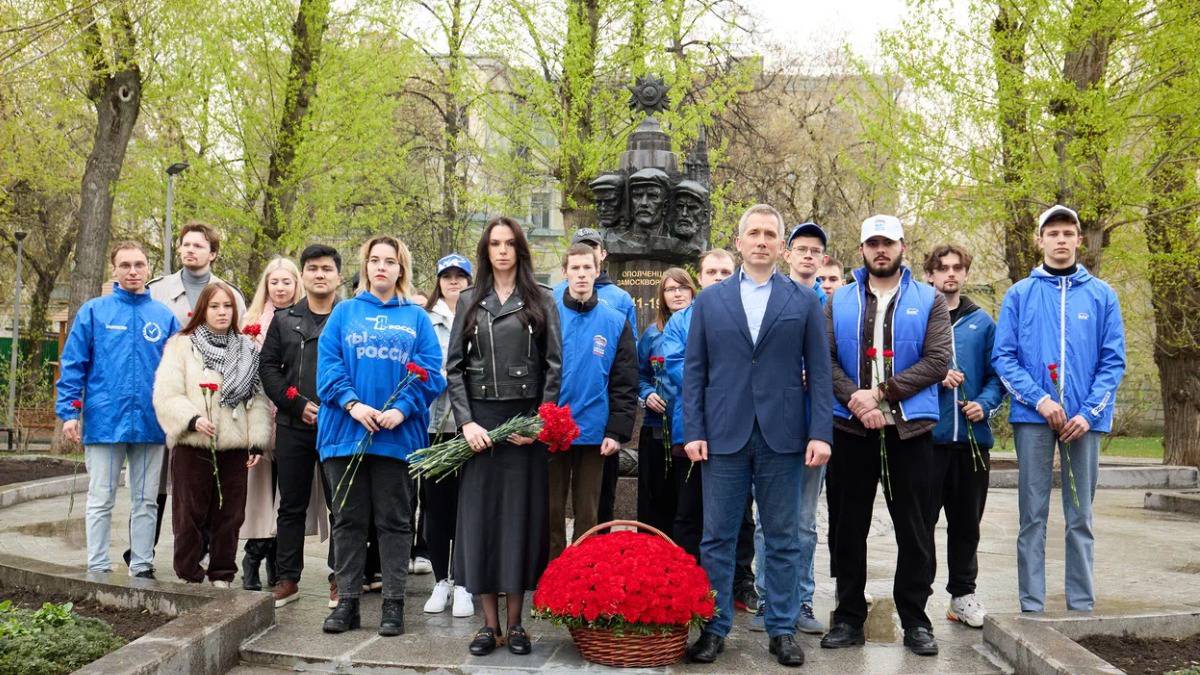
A memorial and sponsorship ceremony dedicated to the International Day of Monuments and Historical Places was held in Moscow as part of the “Historical Memory” project of the United Russia party. Public figures joined the event in different parts of the city, in particular, Eldar Sharipov, a member of the Northern Military District, a veteran, Executive Secretary of the district branch of the United Russia party in the Northern Administrative District of Moscow, and Oleg Leonov, Advisor to the Rector of the National Research University Higher School of Economics, journalist, and supporter of the United Russia party. Together with townspeople and party activists, they laid flowers on monuments in honor of the heroes of the Great Patriotic War and participated in patronage events.
Zamoskvorechye militia
One of the sites of the events was the monument to the Zamoskvorechye militia, located on the square of the same name in the center of the capital.
— On the territory of modern Zamoskvorechye in 1941, the 9th and 17th divisions of the people’s militia were formed. Participants defended the capital from the Nazis at the cost of their lives. Without them, victory in the Battle of Moscow would be impossible. “It is their feat that we remember today here, at the monument to the Zamoskvorechye militia,” said Leonov, who participated in the patriotic event and laid flowers at the monument.
In the summer of 1941, 12 militia divisions were created in Moscow, and four more in October. They were formed from volunteer citizens of different ages and professions: workers, students, school and university teachers, scientists, cultural workers, engineers. It was the militia that played a decisive role in the Battle of Moscow. This battle was one of the largest battles of World War II. More than 7 million people participated in it. No capital in the world offered such a strong rebuff to Hitler’s forces. The Wehrmacht suffered its first serious defeat near Moscow.
The commemorative event, dedicated to the International Day of Monuments and Historic Sites, was held in all 10 districts of the Central Administrative Region and included more than 25 memorials.
North D.C. Walk of Fame
In Dmitrovsky District, SVO member Eldar Sharipov joined the event on the Walk of Fame. On the site where the militia left to defend Moscow in 1941, there now stands a complex of five tombstones, with the District Council of Honor standing nearby. Here students from area schools take the oath and veterans gather.
– At the northern approaches to Moscow in the fall of 1941, German tank armies stopped. We carefully preserve the memory of those who defended Moscow and our entire country from Nazism. In 2017, an unnamed street in the eastern Dijonino district was named after Nikolai Zaryanov, Hero of the Soviet Union. “He participated in the battles on the Western, Don and Voronezh fronts, and fought in the Battle of the Dnieper, where he captured a bridgehead on the river bank and destroyed dozens of Nazis,” Sharipov said.
The “Historical Memory” campaign activities took place in nine areas in the northern region. Residents took care of the monuments that preserve the memory of the heroic deeds of soldiers during the Great Patriotic War. Among them are the plaque “Eternal Glory to the Fallen Heroes of 1941-1945” in the Pezkudnikovsky District, the memorial sign “For All Who Fallen for the Fatherland” in the Koptevo District, and the Monument to the Memory of Railway Workers in the Western Dezhonino District.
“Historical Memory” Project
The United Russia project “Historical Memory” is an initiative aimed at preserving the country’s historical and cultural heritage, including memorials dedicated to the Great Patriotic War.