

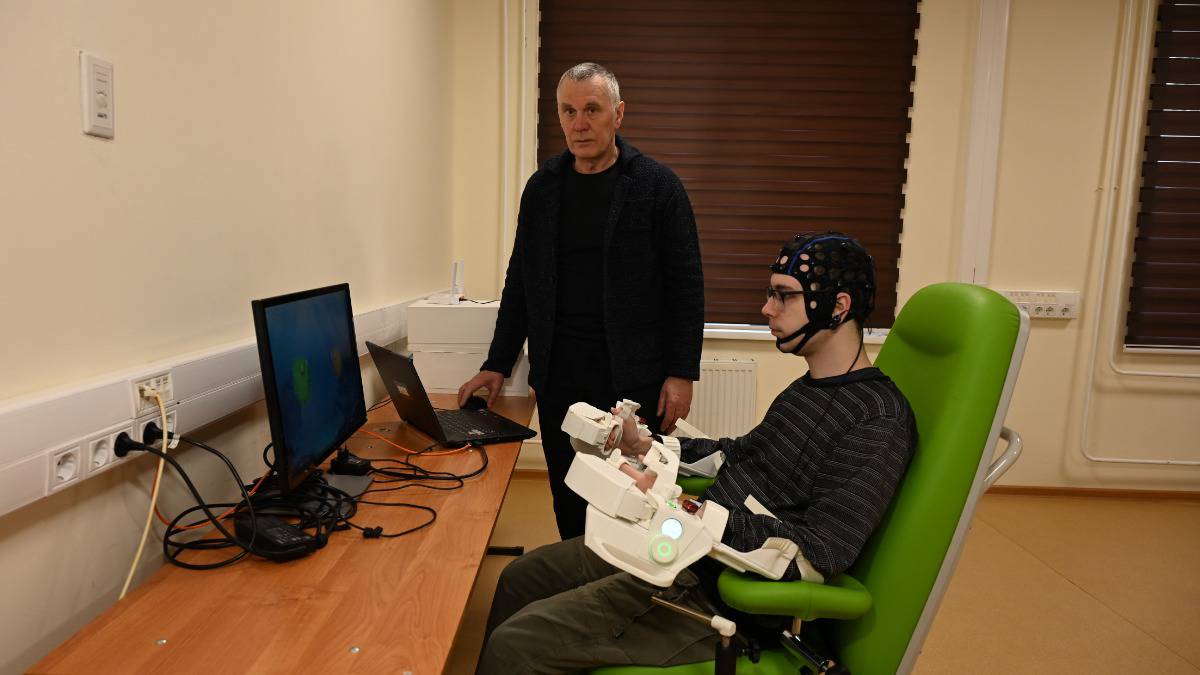
At NI Pirogov Russian National Research Medical University, not only students and teachers work on their projects, but also research scientists. Evening Moscow learned about one of their developments for patients who had an acute stroke.
I don’t even want to imagine what it’s like when you think about how you clench your hand into a fist, but you can’t do it. This is one of the problems that people who have had a stroke face. To correct this, a person will have to undergo a long course of rehabilitation, which can help in the development of the outer hand at Pirogov University.
“Our laboratory was born as a result of the interaction between the RNRMU and the Russian Center for Neurology and Neuroscience,” says Pavel Bobrov, senior researcher at the Department of Brain-Computer Interfaces at Pirogov University. “We explored with him the possibility of using computer and brain systems for rehabilitation. It records the work of the brain and converts the received signals into commands to an external device.
Additional actions are as follows: the patient is asked to imagine that he is performing this or that action. A special cap-shaped device equipped with sensors reads brain signals and creates an electroencephalogram. If the person being rehabilitated does everything correctly, the outer hand attached to his hand begins to squeeze his fingers into a fist.
– It has long been known that the kinetic idea of movement is useful. It is important for the patient to maintain it after a stroke. But from the outside the doctor cannot track whether a person is thinking correctly or not? The expert emphasizes that the external hand was created specifically to solve this problem and show that the patient is completing the task assigned to him correctly.
Research has shown that supplementing standard rehabilitation processes with training with this “feedback” helps speed up motor recovery.
RNRMU continues to develop this technology. The focus now is on making exo-hand technology compact and portable. If earlier for such activity you needed a large special chair, where sitting can be uncomfortable for patients with back problems, today you can connect the system anywhere, even on a simple office chair, not to mention sofas or, for example, wheelchairs.
“Of course, we not only provide medical technologies to make the rehabilitation process more attractive for the patient,” Bobrov shares details. He added: “Today we present them with game scenarios in which we use virtual reality glasses, so that the patient is completely immersed in the task assigned to him.
From the outside it looks, of course, very funny. Man wearing virtual reality glasses sitting. He has a device on his hand, attached to each finger, and an EEG cap on his head. On the screen visible to the doctor, the image repeats what the patient sees in virtual reality glasses: two hands that change colors depending on the correctness of the task.
But patients who tested this technology liked another game more than others – with puffer fish. If a person performs the task of opening his hand well, the fish swells. As soon as it stops holding, it empties. By the way, interested students can join these studies. The men received practical training and conducted experiments. Some have written testimonies relating to research into outside hand work.
By the way
In total, Pirogov University has more than 35 scientific and research laboratories and departments. Its main part is located in the main seven-storey building. But in addition, laboratories are located in university hospitals; Many of these places are closed to people from outside: there is a clean area and everyone entering needs to undergo multi-stage processing.